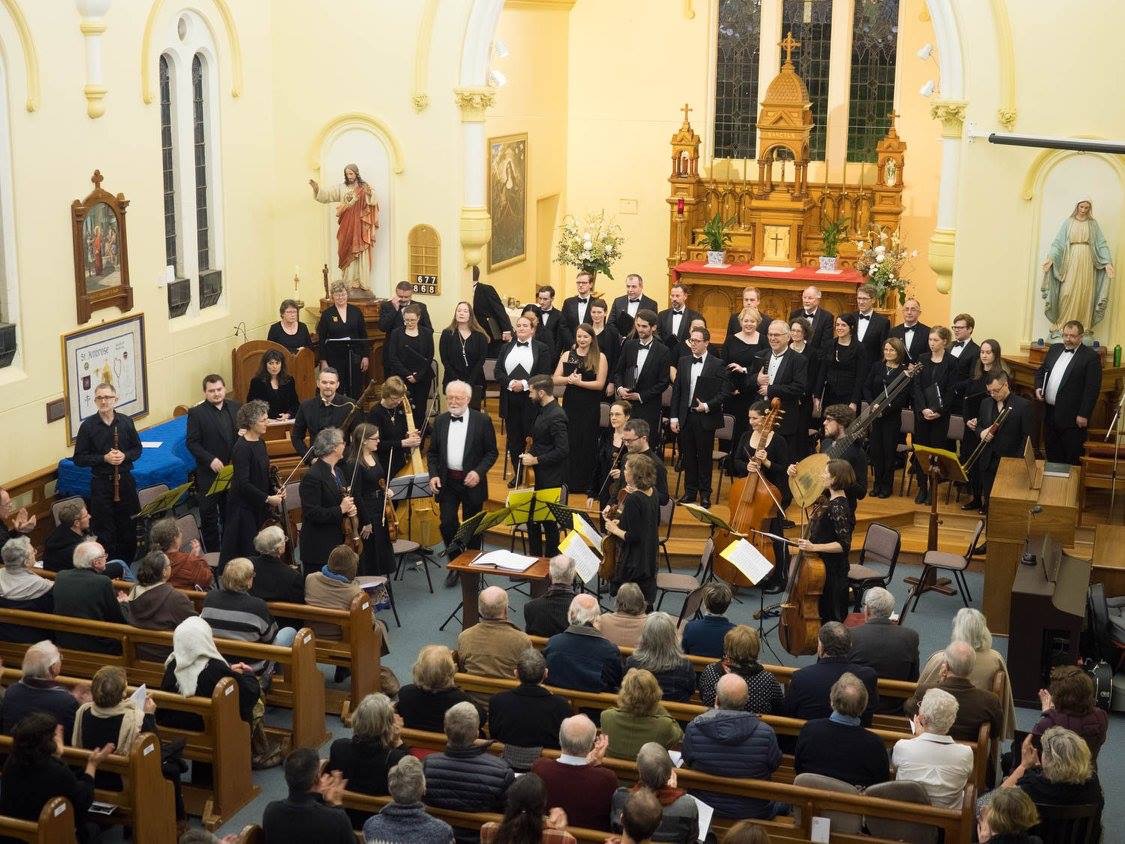
Music for Holy Week (2018)

Music for Holy Week
Sunday, 25 March 2018, 4:00pm

All Saints’ Anglican Church
Chapel Street, St Kilda East
All Saints’ Concert Series 2018

Andrea Gabrieli
Miserere mei, Deus
Thomas Tallis
Incipit lamentatio, De lamentatione
Giovanni Pierluigi da Palestrina
Stabat mater

Soprano
Deborah Summerbell; Carol Veldhoven; Katherine Lieschke;
Victoria Brown; Katharina Hochheiser; Claerwen Jones
Alto
Belinda Wong; Juliana Kay;
Yi Wen Chin; Helena Ekins
Tenor
Tim van Nooten; Stuart Tennant;
Vaughan McAlley; Michael Stephens
Bass
Nicholas Tolhurst; Andrew Murray;
Mike Ormerod; Michael Strasser


Homage to Gombert (2018) [Woodend]

Homage to Gombert
Sunday, 11 March 2018, 3:30pm

St Ambrose Church, Woodend
(This concert was originally performed Saturday 3 March 2018 8:00 pm at Our Lady of Victories Basilica, Camberwell)

This program features three works that are new to our repertoire, in company with a few past favourites. The major work is a Mass by the little-known Philippe Rogier based on a motet by Gombert. This beautiful work suggests that Rogier might hold a rather more significant place in music history if the majority of his output had not been destroyed in the Lisbon earthquake and tsunami of 1 November 1755.

Nicolas Gombert  Magnificat quarti toni 
Adrian Willaert  Ave virgo sponsa Dei
Costanzo Festa  Ave Regina caelorum
Clemens non Papa Ego flos campi 
Nicolas Gombert  Ego sum qui sum
Philippe Rogier  Missa Ego sum qui sum

Soprano
Carol Veldhoven; Victoria Brown; Katherine Lieschke;
Katharina Hochheiser; Claerwen Jones; Julie Robarts
Alto
Belinda Wong; Juliana Kay;
Yi Wen Chin; Emma Warburton
Tenor
Peter Campbell; Tim van Nooten;
Stuart Tennant; Michael Stephens
Bass
Andrew Murray; Nicholas Tolhurst;
Mike Ormerod; Michael Strasser

Thursday Evensong at Trinity College (2018)

Evensong at Trinity College
Thursday, 8 March 2018, 5:45pm
Trinity College Chapel
Royal Parade, Parkville

Hymn: 201
Responses: Ayleward
Canticles: Amner Second Service (Cesar’s Service)
Psalm: 85
Anthem: Tallis I call and cry to thee

Soprano
Deborah Summerbell; Carol Veldhoven;
Katherine Lieschke ; Claerwen Jones; Katharina Hochheiser
Alto
Belinda Wong;
Yi Wen Chin; Niki Ebacioni
Tenor
Tim van Nooten; Peter Campbell
Vaughan McAlley; Michael Stephens
Bass
Nicholas Tolhurst; Andrew Murray;
Michael Strasser

Homage to Gombert (2018) [Melbourne]

Homage to Gombert
Saturday, 3 March 2018, 8:00pm

Our Lady of Victories Basilica
Burke Road, Camberwell

Subscription Concert 1
(This concert was repeated Sunday 11 March 2018 3:30pm at St Ambrose Catholic Church, Woodend)

This program features three works that are new to our repertoire, in company with a few past favourites. The major work is a Mass by the little-known Philippe Rogier based on a motet by Gombert. This beautiful work suggests that Rogier might hold a rather more significant place in music history if the majority of his output had not been destroyed in the Lisbon earthquake and tsunami of 1 November 1755.

Nicolas Gombert  Magnificat quarti toni 
Adrian Willaert  Ave virgo sponsa Dei
Costanzo Festa  Ave Regina caelorum
Clemens non Papa Ego flos campi 
Nicolas Gombert  Ego sum qui sum
Philippe Rogier  Missa Ego sum qui sum

Soprano
Deborah Summerbell; Carol Veldhoven; Victoria Brown;
Katharina Hochheiser; Claerwen Jones; Julie Robarts
Alto
Belinda Wong; Juliana Kay;
Yi Wen Chin; Emma Warburton
Tenor
Peter Campbell; Tim van Nooten;
Stuart Tennant; Michael Stephens; Vaughan McAlley (also Bass 1)
Bass
Andrew Murray; Chris Potter (rehearsed but illness on concert night);
Mike Ormerod; Michael Strasser

Christmas Carols in the Garden (2017)

Saturday 16 December at 4:30 pm
Duneira, Mt Macedon

Selections from 100 Carols for Choirs & Sing Nowell

SINGERS

Soprano
Deborah Summerbell
Carol Veldhoven
Victoria Brown
Katharina Hochheiser
Claerwen Jones
Alto
Mandie Lee
Juliana Kay
Helena Simpson
Tenor
Tim van Nooten
Michael Stephens
Stuart Tennant
Bass
Nicholas Tolhurst
Andrew Murray
Mike Ormerod

Christmas to Candlemas: Around 1600 (2017)

Christmas to Candlemas: Around 1600
With guest artists: La Compañia, The Renaissance Band
Saturday, 9 December 2017, 8:00pm

Xavier College Chapel, Barkers Road, Kew
Subscription Concert 3

The end of the Renaissance and the beginning of the Baroque fuse in this program of festive Continental music for voices and instruments. The choral opulence of this period has seen few parallels at any time or place. Most of this music of this program was created in and for Venice, but the works of Lassus and Praetorius remind us that La Serenissima was not alone in creating festive masterpieces, while the Victoria motet tells us that simple unaccompanied four-voice polyphony was still alive and well at this time.

Michael Praetorius, Resonet in laudibus
Orlande de Lassus, Resonet in laudibus
Andrea Gabrieli, Hodie Christus natus est
Giovanni Gabrieli, Canzona primi toni
Giovanni Gabrieli, O magnum mysterium
Orlande de Lassus, Omnes de Saba
Tomás Luis de Victoria, Senex puerum portabat
Orlande de Lassus, Adorna thalamum
Giovanni Gabrieli, Canzona duodecimi toni
Giovanni Gabrieli, Nunc dimittis a 14

Soprano
Deborah Summerbell; Carol Veldhoven; Katherine Lieschke; Victoria Brown;
Katharina Hochheiser; Claerwen Jones; Mandie Lee
Alto
Belinda Wong; Juliana Kay;
Niki Ebacioni; Yi Wen Chin
Tenor
Peter Campbell; Tim van Nooten;
Stuart Tennant; Vaughan McAlley; Michael Stephens
Bass
Nicholas Tolhurst; Andrew Murray;
Mike Ormerod; Michael Strasser

REVIEW
12 December 2017, O’Connell the Music, [online]
A Double Ending
Clive O’Connell
Christmas to Candlemas: Around 1600
Ensemble Gombert
Xavier College Chapel
Saturday 9 December 2017

For the last Xavier Chapel program – well, it looks that way, and the Ensemble’s three eastern suburb appearances are moving to Our Lady of Victories Basilica in Camberwell next year –  director John O’Donnell brought in the services of Danny Lucin’s early music musicians, La Compania to flesh out a final night for 2017 of lush, almost corpulent Renaissance Christmas music: both Gabrielis, of course, along with Praetorius, de Lassus, and a single Epiphany motet by Victoria.

The program was rich in choral works for multiple vocal lines, interspersed with three Andrea Gabrieli intonationes and a relatively more substantial ricercar from O’Donnell on chamber organ.  Other instrumental pieces included two canzone by Giovanni Gabrieli for eight voices.  Lucin’s cornetto led the quartet from La Compania – sackbuts Julian Bain, Trea Hindley, Glen Bardwell – and the second instrumental choir was represented by O’Donnell; a mixture that worked well enough, even better after ears had adjusted to the organ’s tuning in mean-tone temperament.

The Gombert numbers had expanded slightly with an additional soprano and tenor in the force and the body’s reliability had also been resumed with the return of some absentees from the previous recital.   In all, the ensemble sang eight works, most of them in company with the four wind and organ.  But in the night’s latter stages, we heard two plain works for the standard four lines: the afore-mentioned Victoria piece, Senex puerum portabat, and the less ornate of the two Lassus representatives, Adorna thalamum: both making for a moment of meditative ease as they celebrated the Presentation in the Temple – the Candlemas of this concert’s title.  Like most of the works performed here, these motets moved swiftly through their texts, over too soon for some of us but handled with confidence and dedication.

But the body of the program comprised music of extraordinary stateliness, polished grandeur which summoned up the spirit of what Renaissance church rituals might have been like – mobile and inspirational but completely controlled in movement and expression.  The combined forces opened with two settings of Resonet in laudibus: the first by Praetorius in seven parts, loaded with full-bodied common chords processing past with solid majesty, then the Lassus version for five voices with more polyphonic interest but just as buoyant in its realization of the Christmas Day-celebrating words.

Andrea Gabrieli’s lavishly coloured Hodie Christus natus est, also instrumentally reinforced/doubled, summoned up the phantom of Venice in 1600 through the organized glory of sound blocks combining, alternating and eventually reaching blazing swathes of rich sonic fabric, particularly the focused relish on the word laetantur and the piling on of concords for the final Alleluia exclamations.  This piece enjoyed an exhilarating performance by both Gomberts and Compania musicians, proposing a form of that controlled ecstasy you hear in the B minor Mass’s Sanctus opening, the emotion kept in harness as the composer looks for intimations of the divine in a music of aspiring solidity.

Nephew Giovanni’s O magnum mysterium for double choir of disparate personnel – the first with two sopranos, alto and tenor, while the second holds an alto, tenor and two bass lines – countering each other and combining for stately interweaving strophes, the whole again typified by dramatic restraint without any vocal adventures and reaching its high point not in the final Alleluia but placing a moving focus on the iacentem in praesepio phrase: the core of the text, picturing the Child lying in a manger.  The first statement is chordal, the second more irregular, yet the effect was intensely moving due to the singers’ incisive delivery.

On either side of the smaller-framed four-voice Victoria and Lassus motets came two powerful works.  The first celebrated the Epiphany, that moment in Matthew’s gospel where the Magi enter the Bethlehem stable, even if Lassus constructs a more expansive picture with not just royalty but Omnes de Saba bringing gifts, the nominated kings coming from Saba (Sheba) with the rest of the population, but from Arabia and Tharsis (Spain or Sardinia? ) as well.  This motet, for double choir, has been sung by the ensemble in previous years, although I can’t remember it coming across with such lustrous majesty; the cornetto and sackbuts might have made a difference in this regard. But the score’s fabric in this performance gleamed with high polish, the smooth and opulent movement underlining the significance of those remarkably outlandish offerings  –  gold and frankincense.

Another Venetian blockbuster made for a memorable farewell to the Xavier Chapel, a building which has been fortunate to witness and host the Ensemble Gombert’s performances for many years.  Giovanni Gabriel’s Nunc dimittis is Simeon’s prayer of gratitude for being allowed to live long enough to see Christ, but it also served as a mutual thank-you between these singers and their loyal audience.  For 14 voices divided into three choirs, this construct proved intensely satisfying for its fusion of massively resonant and fluid motion with a non-indulgent handling of the text.  Mind you, the concluding doxology is just as lengthy as the words of the righteous and devout man from Luke’s gospel that were set by the composer.  But O’Donnell and his forces gave us a most satisfying, driving reading of this High Renaissance gem, a potent reminder of the choir’s outright distinction in this country’s choral ranks.

Clive O’Connell/courtesy of O’Connell the Music

Jacobean Composers in the Low Countries (2017)

Jacobean Composers in the Low Countries
Saturday, 28 October 2017, 8:00pm

Xavier College Chapel, Barkers Road, Kew
Subscription Concert 2

For a variety of reasons three of England’s finest musicians of the early years of the seventeenth century became residents of the Low Countries. The major focus of this program is a quattro-centennial performance of Dering’s five-voice motets published in Antwerp in 1617. These are complemented by a brief organ work by Bull and selections from two books of motets by Philips.

Richard Dering Cantiones sacrae 1617 (complete)
John Bull Laet ons met herten reijne
Peter Philips Cantiones sacrae, 1612 & 1613 (selections)

Soprano
Carol Veldhoven, Nina Pereira, Victoria Brown;
Kristy Biber, Claerwen Jones; Mandie Lee
Alto
Belinda Wong; Juliana Kay;
Yi Wen Chin; Rebecca Collins
Tenor
Peter Campbell, Tim van Nooten;
Vaughan McAlley; Stuart Tennant, Michael Stephens
Bass
Andrew Murray, Nicholas Tolhurst;
Michael Strasser; Mike Ormerod

REVIEW
31 October 2017, O’Connell the Music, [online]
Celebration of the displaced
Clive O’Connell
Jacobean Composers in the Low Countries
Ensemble Gombert
Xavier College Chapel
Saturday 28 October 2017

The old order changeth – or so it seems with this excellent ensemble.  For many comfortable years  –  comfortable for us admirers  –  this choir has maintained its own timbre, such that you can usually pick the group out from the ruck: piercingly true sopranos, a steady and prominent alto line, a resonant quartet of basses, and tenors that negotiate the notes, even if diffidently.  Further, the Gomberts’ control of material extended across the centuries, well past the time of their namesake and well into the last century; John O’Donnell could take his 18 singers into any landscape and make them sound content and secure.

Much of this had to do with longevity; a solid core remained in the organization’s line-up, no matter what individuals went or returned, and this continuity of service ensured that the ensemble’s calibre of performance suffered minimally, whether a program comprised Flemish masters of the early-to-mid Renaissance or moved into the realms occupied by  contemporary static Scandinavians.  On top of this, the choir began as it continued, making no compromises for the sake of attracting a wider audience but sticking to its communal last of taking up challenges and producing readings of high musicianship without the slightest trace of populism.

This single-mindedness hasn’t changed, evident from this most recent program given on Saturday night.  O’Donnell and his singers – the number increased slightly to 19 – worked through a focused series of works by recusant composers (well, two of them were; the other used Catholicism as the public justification for his exile) who left England for the more tolerant climate of the Netherlands and Belgium.  Mind you, two of the three composers programmed got short shrift.  O’Donnell played John Bull’s Praeludium voor Laet ons met herten reijne on a chamber organ which emphasized the piece’s progress into angularity and abruptness.  But the piece lasts only about three minutes.  Peter Philips enjoyed a longer hearing with four motets, but the recital’s main emphasis fell on works by Richard Dering – 20 of them.

Right from the opening bars of Philips’ Ave verum corpus setting, you could tell that the Gomberts’ sound had changed; in this work, the suspicion turned to certainty on the word praegustatum where the advent of at least three new sopranos – new to my experience – had altered the line’s timbre, to the point where you wondered about the possibility of someone operating slightly below the set pitch. The effect was hard to pin down because, in this piece for five voices, there are two soprano lines.  Something of the same uncertainty occurred in the following Christus resurgens where the final high notes of the sopranos’ overlapping Alleluia – Fs in my music – missed out on true congruence.

Media vita, set in a more sombre, lower tessitura, made a more favourable impression, possibly because of a calmer dynamic in operation, but the last offering from this composer, Ascendit Deus, held some more flashes of rough delivery, so that the customary smoothness and consistency of product was not sustained.

For the two brackets of Dering motets, O’Donnell accompanied the choir with the provided continuo, occasionally giving his singers a brief respite with an interlude. In the first, pre-interval group, an opening brace of O bone Jesu and O nomen Jesu made a favourable impression with several passages of quietly assertive declamation.  The sopranos didn’t pick out their opening to Jesu dulcis memoria carefully enough; the tenor lines in Quando cor nostrum sounded unusually thin, then pretty tired in the second line of Desidero te millies although the chromatic slipping at the end of that motet came across with fine accomplishment.

The composer’s works proved full of surprises in word-setting, rarely lingering over a phrase and all too happy to get past an awkwardness like incompraehensaque bonitas with some dispatch.   But even a bucketful of compositional felicities could not disguise a dominance of the choir’s texture by the top line/s with an agreeable murmuring from the bass quartet but no commensurately prominent counterweight; it made you long for the presence of old-time regulars like Jerzy Kozlowski and Tim Daly.

The second group of Dering motets began with a fine reading of Anima Christi which alternated solo voices with the full choir, the sudden emergence of individuals a welcome change, although something odd happened in the final speravi in te where the combined texture appeared to undergo a dynamic gap.  The same technique worked to more confident effect in the following Vox in Rama and the women’s voices carried the burden for Dixit Agnes with as much assurance and directness of address as in years past.  A fine emotional flare informed the horticultural rhapsody of rubicunda plusquam rosa, Lilio canbdidior that concluded the deceptive Ave virgo gloriosa where the singers dipped into a sequence based on the Song of Songs.

Approaching the end, the well-exercised singers found sufficient energy to outline the suspension chain in Contristatus est Rex David where the king mourns his faithless son. But the central O sanctum signum Cruce, adoramus te in Omnem super quem returned us to the opening qualms about the upper line’s pitch, a problem that continued into the final Ave Maria.

This year is the 400th anniversary of the publication of Dering’s five-voice Cantiones sacrae and I can’t imagine that another celebration of this event would be as carefully researched and prepared as this program was.  Certainly, the night shone a battery of lights in a dark place as Dering is not a name that emerges often in Catholic choral ceremonies, although he is  –  somewhat perversely  –  not so much of a stranger in the Anglican church.

The Gomberts have cut down on their appearances in recent times; this year, they are presenting only three Xavier Chapel nights, and making a single appearance in the Melbourne Recital Centre.  You can only hope that the new choir members settle more firmly into the body’s long-time high level of performance, even though the opportunities for such acclimatization are becoming more rare.

Clive O’Connell/Courtesy of O’Connell the Music

Choral Music of the Early German Baroque @MRC (2017)

Monday, 11 September 2017, 6pm
Melbourne Recital Centre – Salon
Choral Music of the Early German Baroque
Melbourne Recital Centre Local Heroes Series 2017

Michael Praetorius
Magnificat super In te Domine speravi
Jesaia dem Propheten das geschah
Heinrich Schütz
Musicalische Exequien
John O’Donnell, director & organ

Singers
Soprano
Debby Summerbell, Carol Veldhoven, Nina Pereira, Katherine Lieschke;
Victoria Brown, Katharina Hochheiser, Claerwen Jones
Alto
Belinda Wong, Yi Wen Chin;
Niki Ebacioni, Rebecca Collins
Tenor
Peter Campbell, Tim van Nooten; Vaughan McAlley
Michael Stephens, Stuart Tennant
Bass
Andrew Murray, Nicholas Tolhurst;
Michael Strasser; Mike Ormerod


Vivaldi Vespers (2017)

Saturday, 10 June 2017, 3:30 pm
Sunday, 11 June 2017, 7:30pm
St Ambrose Church, Woodend

Woodend Winter Arts Festival

PROGRAM
Deus in adjutorium (RV593)
Dixit Dominus (RV595)
Laudate pueri (RV602)
Confitebor (RV596)
Beatus vir (RV597)
Lauda Jerusalem (RV609)
Magnificat (RV610)

Antonio Vivaldi, known in his day as “the Red Priest” (on account of his red hair), is known in our day mainly as the composer of 500-odd concertos, especially those called The Four Seasons. But he was also a prolific composer of church music, of which a splendid Gloria is the only piece to have achieved superstar status in our time. Much of his Vespers music awaits discovery by the larger musical public. For the opening and closing items we have only a single setting, but for the five intervening psalms we have to choose from an embarrassment of riches: for example, there are three wonderful settings of Dixit Dominus, of which only one must be selected. Most pieces are being performed for the first time in Australia.

SINGERS
Soprano
Deborah Summerbell; Carol Veldhoven; Katherine Lieschke; Victoria Brown;
Katharina Hochheiser; Claerwen Jones; Mandie Lee; Sarah Harris
Alto
Belinda Wong; Juliana Kay; Elizabeth Chong;
Yi Wen Chin; Niki Ebacioni; Rebecca Collins
Tenor
Peter Campbell; Tim van Nooten; Daniel Riley;
Vaughan McAlley; Michael Stephens; Stuart Tennant
Bass
Andrew Murray; Adrian Phillips; Nicholas Tolhurst;
Thomas Bell; Mike Ormerod; Michael Strasser

SOLOISTS
Katherine Norman, soprano
Kristy Biber, soprano
Christopher Roache, alto
Daniel Thomson, tenor
Jerzy Kozlowski, bass
Accademia Arcadia
Directed by John O’Donnell

REVIEW

15 June 2017, Facebook, [online]
Vivaldi Vespers
Paul Selar
Ensemble Gombert and Accademia Arcadia
St Ambrose Church, Woodend
Sunday 11th June 2017

Every Queen’s Birthday weekend, the town of Woodend is the setting for a small but quality Winter Arts Festival, now in its 13th year. I hadn’t been before but I was drawn to it for the Australian premiere performance of Vivaldi Vespers (I also have friends in nearby Kyneton).

In the red brick, neo-Romanesque St Ambrose Church, Ensemble Gombert, numbering 26 singers, and the 16 musicians of Accademia Arcadia took to the altar for an evening of uplifting music led by John O’Donnell. Sung in Latin, the program – Deus in adjutorium (RV 593), Dixit Dominus (RV 595), Laudate pueri (RV 602), Confitebor (RV 596), Beatus vir (RV 597) and taking Lauda Jerusalem (RV 609) to an interval before bringing Concerto in due Cori Per La S. Sma. Assontione di M. V. (RV 582) and finishing with Magnificat (RV 610) – shone in glorious form. In praise of God, believer or not, its beauty is transforming. Indeed, the Church had the tools to attract and intoxicate its followers! The English translation appears in the program notes but you didn’t really need it as an aid.

The hum, buzz and warmth of Accademia Arcadia’s fine playing gave vividness and radiance to the evening and there was some lovely singing from the soloists – sopranos Katherine Norman and Kristy Biber, countertenor Christopher Roache and tenor Daniel Thomson – but it was Jerzy Kozlowski’s generous smoky bass that most impressed. The combined voices of Ensemble Gombert catapulted the evening even higher, their well-rehearsed, crisp, precision-timing and attentive modulation of sound showing pleasing reliability.

Violinist Davide Monte, a festival regular, led the proceedings for Concerto in due cori RV582 in an untiring, virtuosic and knockout performance – a showman and a delight to watch. Andrew Angus, on oboe, had frighteningly tricky extended solo leaps across the stave to make but the music emanated, if not completely intact, at least deliciously warm and amber-toned. The strings excelled as Artistic Director and founder of the festival, Jacqueline Ogeil, provided well-balanced support at the organ.

Packing the little church, the audience of around 150 loved it. Just one hour out of Melbourne, it was one well-worth-the-effort of a trip and now has me looking at making a future visit next Queen’s Birthday weekend to sample more.

Paul Selar, Herald-Sun opera critic/Public Facebook post

Vivaldi Vespers WWAF 2017

YEARLY ARCHIVE

2026 (1)2025 (7)2024 (7)2023 (5)2022 (6)2021 (4)2019 (8)2018 (16)2017 (9)2016 (9)2015 (13)2014 (10)2013 (10)2012 (7)2011 (12)2010 (8)2009 (11)2008 (8)2007 (7)2006 (12)2005 (9)2004 (11)2003 (6)2002 (8)2001 (4)2000 (9)1999 (7)1998 (9)1997 (8)1996 (8)1995 (7)1994 (1)1993 (1)1992 (5)1991 (1)1990 (3)